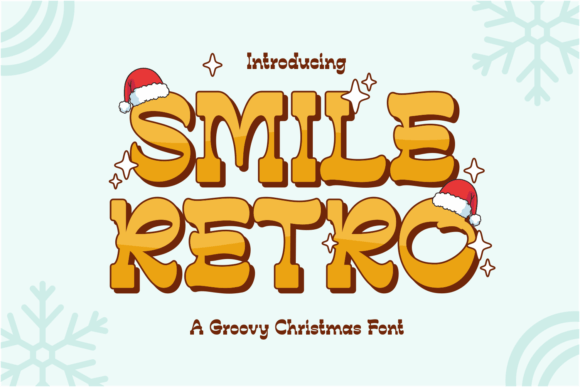
Smile Retro: A Nostalgic Approach to Holiday Typography
The holiday season presents a unique challenge for designers, marketers, and content creators. The market is saturated with seasonal imagery, from traditional red-and-green motifs to modern minimalist aesthetics. Standing out requires more than just festive colors; it demands typography that communicates warmth, personality, and a distinct point of view. This is where Smile Retro enters the conversation. As a groovy Christmas font, it bridges the gap between mid-century nostalgia and contemporary design needs, offering a playful yet professional tool for holiday communications.
For professionals aged 20 to 50 who manage brand identities, create social media content, or design physical merchandise, understanding the nuances of thematic typography is essential. Smile Retro is not merely a decorative element; it is a strategic asset for brands aiming to evoke specific emotional responses. By infusing holiday cheer with a touch of nostalgia, this typeface allows creators to craft messages that feel both familiar and fresh. Its value lies in its ability to soften corporate edges and humanize digital interactions during a high-traffic commercial period.
Deconstructing the Aesthetic of Smile Retro
To evaluate the utility of any typeface, one must first understand its structural DNA. Smile Retro draws heavily from the typographic trends of the 1960s and 1970s, an era characterized by bold curves, organic shapes, and a rejection of rigid geometric strictness. However, it adapts these historical references for modern legibility and digital rendering.
The font’s primary characteristic is its playful irregularity. Unlike standard sans-serifs that prioritize uniformity, Smile Retro introduces subtle variations in stroke weight and letterform curvature. This creates a hand-drawn impression without sacrificing the consistency required for professional layouts. The letters often feature rounded terminals and open counters, which contribute to an approachable and friendly visual tone. When applied to holiday messaging, these characteristics translate into a sense of whimsy and inclusivity.
Furthermore, the "groovy" aspect of the design is evident in its alternate glyphs and ligatures. These features allow for customization, enabling designers to break the monotony of repeated characters in headlines. For instance, varying the style of the letter "S" or "R" in a phrase like "Season’s Greetings" can add visual rhythm and keep the viewer engaged. This level of detail is crucial for short-form copy, such as Instagram captions, email subject lines, or packaging labels, where every character counts.
Practical Applications in Modern Marketing
The true test of a niche font like Smile Retro is its versatility across different media formats. While it is explicitly marketed as a Christmas font, its application extends beyond traditional holiday cards. Here is how various professionals can integrate it into their workflows:
- Digital Marketing Campaigns: Email marketing sees higher engagement during the holidays, but inbox clutter is intense. Using Smile Retro in subject lines or header images can increase open rates by signaling a personalized, less corporate tone. It works particularly well for lifestyle brands, boutiques, and creative agencies looking to connect on a human level.
- Social Media Graphics: Platforms like Instagram and Pinterest rely heavily on visual appeal. The bold, retro nature of Smile Retro ensures readability even on small mobile screens. It pairs effectively with flat-lay photography, vintage-inspired illustrations, or bold color blocks, making it ideal for carousel posts and story highlights.
- Product Packaging and Labels: For small business owners selling artisanal goods, food items, or handmade crafts, packaging is a key touchpoint. Applying Smile Retro to limited-edition holiday wrappers or tags adds perceived value and authenticity. It suggests care and attention to detail, aligning with the consumer desire for unique, non-mass-produced gifts.
- Web Design Elements: While not suitable for body text due to its decorative nature, Smile Retro excels as a display font for website banners, landing page headers, and call-to-action buttons during the holiday season. It can temporarily refresh a brand’s digital presence without requiring a complete site overhaul.
The key to successful implementation is restraint. Because the font carries strong personality, it should be used sparingly to highlight key messages rather than overwhelming the design. Pairing it with a clean, neutral sans-serif for supporting text creates a balanced hierarchy that guides the eye without causing visual fatigue.
Evaluating Usability and Technical Performance
From a technical standpoint, the reliability of a font file is as important as its aesthetic appeal. Professionals need assets that integrate seamlessly into design software such as Adobe Illustrator, Photoshop, InDesign, and web-based tools like Canva. Smile Retro is designed with modern vector standards, ensuring scalability without loss of quality. Whether resized for a billboard or a favicon, the curves remain smooth, and the edges stay crisp.
Legibility is another critical factor. Many decorative fonts suffer from poor readability, especially at smaller sizes or in low-contrast situations. Smile Retro mitigates this risk through its open letterforms and adequate spacing. However, users should remain mindful of context. It is not recommended for long paragraphs or dense informational text. Its strength lies in headlines, titles, and short phrases. Testing the font across different background colors is advisable to ensure sufficient contrast, particularly when using traditional holiday palettes like deep reds or forest greens.
Compatibility is generally broad, supporting standard Latin characters, which makes it suitable for English-speaking markets and many European languages. For global campaigns, creators should verify specific character support for their target regions. The font’s flexibility allows for easy manipulation in design software, enabling users to adjust tracking, kerning, and leading to fit specific layout constraints.
Who Benefits Most from Smile Retro?
While any creator can appreciate a well-designed typeface, certain groups will find disproportionate value in adding Smile Retro to their toolkit:
- Small Business Owners and Entrepreneurs: Those who handle their own marketing often lack the budget for custom illustration. A distinctive font like Smile Retro provides a quick way to elevate DIY designs, making them look professional and curated.
- Freelance Designers and Agencies: Having a diverse library of thematic fonts allows designers to respond quickly to client requests for seasonal work. Smile Retro offers a specific stylistic niche—retro nostalgia—that may not be covered by more generic holiday fonts.
- Content Creators and Bloggers: Visual consistency is key to building a personal brand. Using a unique font for holiday-themed blog headers or YouTube thumbnails can help maintain brand recognition while adapting to seasonal trends.
- Educators and Non-Profits: Organizations aiming to spread joy or community spirit can use the friendly nature of Smile Retro to make announcements, event invitations, and newsletters feel more welcoming and less institutional.
Limitations and Strategic Considerations
No design tool is universally applicable, and honest evaluation requires acknowledging limitations. Smile Retro is highly stylized, which means it may clash with brands that adhere to strict minimalist or ultra-corporate identity guidelines. If a brand’s core voice is serious, authoritative, or tech-focused, this font might dilute that message unless used ironically or in very specific, isolated contexts.
Additionally, trend sensitivity is a factor. While "retro" has shown remarkable longevity in design cycles, it is still a trend. Overuse can lead to visual saturation. To maximize long-term value, consider how the font fits into a broader design system. Can it be adapted for other seasons? The playful, rounded nature of Smile Retro could potentially work for spring campaigns or birthday celebrations, extending its utility beyond December.
Another consideration is accessibility. Designers must ensure that the decorative nature of the font does not hinder readability for users with visual impairments. Always provide alternative text for images containing this font and avoid using it for critical navigational elements or legal disclaimers.
Final Thoughts on Integrating Nostalgia into Design
In an increasingly digital and fast-paced world, nostalgia serves as a powerful anchor. It connects consumers to memories of simplicity, warmth, and community. Smile Retro leverages this psychological trigger effectively, offering a typographic solution that is both fun and functional. For professionals seeking to enhance their holiday communications, this font represents a low-risk, high-reward investment.
Its success depends on thoughtful application. By respecting its decorative nature, pairing it with complementary typefaces, and using it to highlight rather than overwhelm, creators can harness its full potential. Whether you are designing a single social media post or a comprehensive holiday campaign, Smile Retro provides the stylistic flair needed to capture attention and spread genuine Christmas joy. It is a reminder that in design, as in life, a little bit of personality goes a long way.